
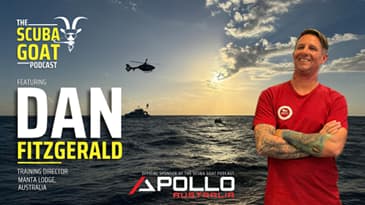

No matter how well we prepare, some incidents occur due to an accumulation of minor faults and a change in conditions. Think you're a safe scuba diver because you have a DSMB, a torch, or signalling mirror? Think again... Dan Fitzgerald and his student Stu spent almost 24 hours at sea, having been swept off the dive site (Flat Rock, North Stradbroke Island) by strong current. They aborted the dive and ascended only to find that the weather had kicked up. The dive boat was a distant image, only seen as they crested the now 2.5m waves.
Dan and Stu were adrift.
Search aircraft passed overhead. Their signals went unseen. And as daylight faded, they faced the prospect of spending the night in open water, with no way of knowing when they would be found.
In this episode of The Scuba GOAT Podcast, Dan takes us back to those hours. The decisions, the doubts, the humour, and the determination to stay together and make it through until morning.
Dan also speaks openly about the mistakes they made before the dive. Sharing those errors takes courage, and he does so to help other divers learn from their experience and avoid making the same mistakes.
He reflects on the lessons he carries with him and his gratitude to the search teams and Gold Coast Westpac rescue helicopter crew who helped bring them home.
This is Dan Fitzgerald. And this is Adrift.
Watch or listen now on The Scuba GOAT Podcast website and YouTube.
Do you have feedback or an opinion to share with us? SMS us now.
Love the show?
Reviews help us grow and let us know you're listening - If you can spare two minutes, please leave a review here.
Want to be a guest on the show?
GREAT! - use this link, drop your details & let's get chatting.
Dive Travel with Nomadic Scuba
Everyone needs a solid travel buddy… Founded by Matt, Nomadic Scuba is an online booking agency for scuba divers. Chances are, Matt himself will sort out your trip - he’s a bit of a planning geek (and loves it!). Check out Nomadic Scuba today and Breathe life into your adventure!
Shopping
Scuba GOAT Amazon Shop - Click here to view
Advertising
Interested in advertising on the show? Sponsoring an episode or partnering with us? Get in touch today for more details on how we can work together.
🎵 Music: Forever Young by the legend - AudioCoffee | AudioCoffee.net
Thanks for listening legends!
Want to be a guest on the show?
GREAT! - use this link, drop your details & let's get chatting.
🎵 Music: Forever Young by the legend - AudioCoffee | AudioCoffee.net
Reviews: If you can spare 5 minutes and would like to support the show we would highly appreciate a 5-star review. Please use this link:

[00:00:01] Hey there dive buddies and welcome to the show. My guest today is Dan Fitzgerald, a dive instructor whose love for the ocean has taken him around the world from the Florida Keys to the remote island of Nui in the South Pacific and on to the remarkable diving around North Stradbroke Island. Earlier this year it was a training dive at Flat Rock that left Dan and his student facing a situation neither had ever imagined.
[00:00:26] Swept away by strong currents they surfaced far beyond the dive site and as the hours passed daylight began to fade. What follows is a frank account of how they faced that night together. The decisions, the doubts, the humor and the determination to keep going. Dan speaks openly about what he would change, what helped them endure and the fabulous people who work to bring them home.
[00:00:50] His honest feedback and willingness to share their story is a lesson in itself that all divers should learn to adopt. I'm grateful he's here to tell the tale and this is Dan Fitzgerald, Adrift. Welcome to The Scuba GOAT Podcast with Matt Waters. Let's dive right in. Well I suppose the first thing to do is find out how the heck you got into diving. Where did it all start?
[00:01:17] Well a number of years ago, how old was I? I think I just turned 30 or just before and I was working in the surf industry at the time for Rip Curl because my background is in surfing and skateboarding and things like that. So I was working for Rip Curl at the time, which was a pretty fun job as well and did a trip to the US and Canada with a buddy of mine. And we'd been up in Canada in Whistler and snowboarding and having a lot of fun.
[00:01:47] And a good friend of mine lived down in Florida in the Florida Keys and was working there as a dive instructor. He'd kind of said, well come down and I'll teach you how to dive sort of thing. Like I'd never even considered diving like in the water all the time, surfing and wakeboarding and all that sort of stuff, but had never been exposed to diving prior to that. I'd never even considered it to be honest.
[00:02:13] And then, yeah, my buddy said, yeah, come down and I'll teach you how to dive. And I was like, no, I don't know about this whole diving thing. And then he said, oh, but spring break's on at the moment as well. Spring break I'd obviously had heard of. So down I went and spent some time down in Key Largo with him. And he put me through my open water course down there. Absolutely beautiful, beautiful part of the world, the Florida Keys and lovely diving.
[00:02:40] And yeah, I was kind of hooked from that moment on. I remember kind of we did the last dive of the course and we're riding in on the back of the boat and sun's going down and all magic. And he's kind of said, yeah, this is my office. And I just thought that was absolutely spectacular to be able to do that sort of thing for a job. So I kind of came back and got back into work.
[00:03:06] And on my day off, I kind of went wandering around the Gold Coast, the southern end of the Gold Coast in Coolingatta into dive shots. And going, this is where I am now. And, you know, I want to be a dive master instructor. What's the pathway to kind of do that? Because I knew absolutely nothing about it. Ended up in a place called Coolie Dive. Which unfortunately doesn't exist anymore. The father and son ran it. And they were both very passionate divers and very welcoming.
[00:03:33] And kind of they sort of took me under their wing. I kind of got a good feeling about them and about the business. So I, yeah, kind of on my days, I wasn't working for Root Curl. I was down there moving my way through courses and getting experience. And kind of went right through to instructor with them. And pretty much the day I passed my instructor exams, I kind of resigned from Root Curl and went and started working there full time instead.
[00:04:03] And that was in kind of 2010, 2011. And that's all I've been doing pretty much ever since. It's funny you say that, you know, you've got a good feeling of the dudes when you walked into the shop. And it's come up a few times. I'm sure it's come up in the conversations you've had around the world as well. But newbies asking, you know, where's the best place to do? Well, the best place to do is the place that you feel the most comfortable and the most content with the people that are teaching you. Yeah, exactly. Like I completely agree.
[00:04:33] And no one instructor is going to be perfect for every person that's out there. And especially when you move into things like professional training and definitely tech and rebreather, having someone that you really connect with is just as important as their certs and their resume, so to speak. And yeah, that's what I got with these guys. And I got some amazing diving in down there and learned a lot of things working for them.
[00:04:59] So I'm eternally grateful that I ended up there doing my initial training. Yeah. And how long did, what was the process like with, you know, going from being a newbie in the dive in to, say, dive master and instructor? I kind of did my sort of dive master internship, so to speak, over about 12 to 18 months because it was while I was still working as well. So I was just down there on my, I do my five days at Rip Curl and I'll be down at Cooley Dive on my two days off.
[00:05:28] So it did take a bit of time, which I think is also a good way to do it. Like that way I was exposed to a lot of different dive conditions, a lot of different divers, a lot of different customers. Rather than just being jammed into a short little period, I kind of, you know, got to see everything about the area. Yeah. And that paid off in doing, doing later courses. If I had been able to take three months off work and go and just do it all, then I probably would have.
[00:05:58] But financially at the time, there's no way in hell I could have swung that. And then I was just, just lucky that I managed to talk my way into a job with them when I finished my instructor course. So I went straight from, from one industry and jumped into, to the other and then was there with them for, for about three, four years after, after that point. Nice. Nice. And what's, what pride you away from there then? I wanted to go overseas.
[00:06:23] So kind of that had been the, the original goal when I first said, I'm going to become a dive master instructor as I wanted to get that and then disappear overseas to some sort of tropical location. Didn't have a house or kids or anything at that time. So seemed like the time to do it. And I ended up getting an offer for, for a job in a place called Nui, which is out in the middle of nowhere, out in the South Pacific. And that was in 2014.
[00:06:54] Yeah. To go out there, which was for initially just going to be a season, but I ended up out there for, for two years. And it's just this tiny little island out in the South Pacific. It's actually the world's smallest self-governing nation. It's kind of out, out towards where Samoa is sort of thing. And you just got the, the absolutely clearest ocean water in the world. Some of the friendliest people you'll ever meet. And, um, you know, what I still think is, is just some absolutely amazing diving.
[00:07:22] So, um, yeah, I kind of, um, finished up at Cooley Dive and headed out there. And, um, Shani, my, my wife, we'd only just started dating. Um, we'd only been together a few months at that stage. Um, and I convinced her somehow to, um, pack everything up that she owned and, and move over there with me. So, so off we went and then, yeah, spent two years living the kind of tropical island sort of lifestyle.
[00:07:49] Um, me working at the dive shop and her teaching at the, at the local school. And that was a lot of fun. Oh, that's awesome. That's awesome. Hey, you're very fortunate, fortunate there to be able to get it as a, you know, a joint venture, um, you know, rather than being stuck in the middle of nowhere on your own. Yeah, definitely. And yeah, that was, that was a very nice experience for both of us. Um, went back a couple of years ago and took our young one over with us.
[00:08:17] So, and that was spectacular as well to go back and see it all again, kind of seven or eight years later now in a different stage of life with a, with a child and married and all of that sort of stuff. So that was really good too. But yeah, so we did that for, for two years kind of over there. And, um, if anyone can tell you that's worked in, in those sort of locations, um, it's, it's generally you're there for the lifestyle, like for the beautiful diving and the warm water,
[00:08:44] the money normally isn't all of that great doing those jobs, but the running joke is yeah, you've got a wallet full of great lifestyle. Um, so yeah, after a couple of years, it was okay. Kind of getting on should probably look at going back somewhere where if I'm going to do this, I can, I can make an actual career out of it and, and maybe earn a bit more money and upskill and, and stuff like that.
[00:09:08] Um, um, um, I'd kind of gotten into technical diving just before I left for Nui. Uh, and I don't really have, have any of that sort of thing in Nui. It's pretty much all recreational diving. So I was, um, pretty keen to go back and work somewhere, um, that had technical diving and rebreather diving. Um, so I could start to progress as a diver and as a trainer doing that sort of thing. Yeah. Yeah. Oh yeah. It's funny.
[00:09:38] I did it. I did a year out at Tufi Resort in Papua New Guinea on my own. And, um, you know, it, it resonates when you say that you're there for the, for the lifestyle and not the debt, not the dollar. But, um, even though I was only there for a year, it feels so much like a second home, even more so than anywhere else I've, I've lived, you know, it's a marvelous experience. And I think everyone, anyone who gets into this industry should do something remote, even if it is just for a year, you know, I loved it. Yeah. Me too.
[00:10:07] And I mean, it's good for your problem solving and stuff like that because you, places like that, you can't just run down to your nearest Bunnings or your nearest Woolworths or, you know, um, I'm hungry. I'm going to call in Uber Eats or something like that. So it's, um, it's quite cool to live in, in somewhere that's a little bit remote. Um, we had a cyclone come through while we were over there. Um, and it's the, the island just kind of goes into lockdown and, um, the places that
[00:10:36] far out in the middle of nowhere that, you know, if you lose internet and all that sort of stuff, like you've got zero idea what's going on in the world. Like, well, World War three could start and you wouldn't know about it until the monthly container ship didn't turn up. We used to lose, uh, internet all the time. It was, um, the, uh, the, the, the radio mass somehow it was powered by, um, a diesel generator of some sort.
[00:11:01] So, um, when the locals got a bit short on, on fuel, go up there and nick the diesel and bye-bye internet until the next time we've got a refill. So, um, as I said, like it's, it's character building that sort of thing. And you learn, learn problem solving and thinking on your feet and, and even the ability to do without things that we don't generally do without, um, uh, in a place like Australia. So yeah, all in all really, really, really good experience.
[00:11:29] Um, but yeah, prior to heading over there, um, I'd gone down and done technical training with Dive Victoria in Melbourne. Uh, there was a, a couple of good friends of mine. Um, one who worked in the industry and one who didn't, um, all of us wanted to do technical training. We'd be kind of looking for, for somewhere that'd be a bit out of our comfort zone. So rather than going to like a, like a alley or one of the warm water places to do it, we
[00:11:57] were like, no, let's go somewhere like coal, you know, challenging conditions, challenging visibility, you know, something that's going to be, be kind of a bit of a, a challenge to do the course. And it definitely was first time I'd been in water that cold and the visibility that, um, that variable, um, for, for a polite word for it, um, absolutely spectacular diving. And I think it kind of like doing the course in those conditions kind of made us better
[00:12:25] divers by the end of it and having the sort of conditions. Um, so yeah, in Neway for two years and kind of, I really wanted to get back to some way where I could do that sort of diving and progress and, um, and actually got offered a job to come back and work at Dive Victoria. Okay. Which I thought would just absolutely fantastic. Like they had multiple boats and technical dives and courses going on all the time.
[00:12:53] So it just seemed like a, um, a really cool busy center to, to work at and be a part of and, um, definitely to progress both, both career and as a diver. Yeah. Yeah. Well, before we go over to Victoria and just back to Neway, um, for, I mean, I don't know how to get there. I'm sure there's many people who will listen whenever clue it even exists. So a, how'd you get there? And B what's the attraction to the dive in there? Is there anything that stands out significantly?
[00:13:21] So you go via Auckland to get out there. Um, like a lot of those Pacific islands, that's about a, a three hour flight from Auckland. Um, at the time they had, um, on the low season, one flight a week in the peak season, two flights a week. Um, it's kind of out sort of towards where, where Samar is. Um, but it's actually, uh, it's a raised coral atoll. So there's not really any rivers. There's no runoff small population.
[00:13:49] So there's very, very little pollution as well. So you've got just some of the, the clearest ocean water in the world, like visibility. The two years I was there didn't drop below 40, 50 meters, you know, amazing days. You, you have it, you know, 70, 80 meters plus, like it's just super, super clear. Um, which actually made it, um, made it entertaining when you're going and doing night dives or doing night courses.
[00:14:16] And, um, especially courses, you're getting students to go on. Okay. We're going to cover our torches so you can see what the effect of the dark is. So you cover your torch and everyone can still bloody see each other because it's just that clear. All right. Well, that was an absolute waste of time. So let's, um, let's get right next to the water and talk about what we did sort of thing. Um, but yeah, just, just super, super clear. Um, uh, it gets, they had a whale population that comes through the same as, um, Tonga.
[00:14:45] Um, through the, the winter period, um, we'd do the, um, swim with the whales, kind of snorkel with the whales sort of thing. And big populations of spinner dolphins, um, as well, we'd, um, we'd snorkel and dive with too. Um, the, the biggest attraction for me is there's a, um, a sea crate that's endemic to the, the island called the Katawali. Um, and these are air breathers.
[00:15:12] So they're, they're constantly kind of swimming up from the bottom to have a breath and going back down. And when you're swimming along at one of the sites called snake gully, um, it looks like just hundreds of pieces of ribbons in the water, kind of going up to the surface, something really, really spectacular. Um, and there's, there's sea caves all over the island. Cause being, being raised coral, it's just like a block of Swiss cheese. So there's all these amazing sea caves to swim into and, and have a bit of a play. And, um, there's a couple of them.
[00:15:41] You can actually surface inside the cave and it's like a pressurized air pocket in there. And you'll have the sea crates, the Katawali coming in to lay eggs up on the rocks in the air because they're air breathers. And then on, on the roof, you'd have these giant coconut crabs that are coming into the cave to lay their eggs in water. So as you're looking up and there's giant crabs and looking down and there's snakes everywhere. It's yeah. Like, like something out of Jurassic Park. It's just absolutely spectacular.
[00:16:12] I just have a look on the map there when you were talking, it is in the middle of nowhere, isn't it? Yep. Yep. So, so you don't have like big, big life. Um, you know, like we get off the East coast of Australia is a little bit rarer there because of how far out in the middle of nowhere it is. Um, like we get the odd manta ray or whale shark and stuff like that, but, um, more like, you know, things that are stopping off rather than populations that live in the area.
[00:16:38] Um, uh, except then the whales of course were, were seasonal. They'd be there every single year. Um, which was quite a cool thing to experience as well. And you get to dive with the whales or, uh, you know, snorkel strokes. You see them occasionally diving, but it was, um, it was snorkel tours. Um, the, the new ones have always been very proactive, um, about care and responsibility for their wildlife and the ocean environment because it's such a big part of their, their life.
[00:17:08] Um, so it was, um, heavily regulated the swimming with the whales, which was, was fantastic. It was only a few operators that would do it strict rules. We had to follow. It was only snorkeling. Um, so it was, was very well controlled. Um, and the, but the tourists coming there compared to somewhere like a, like a Fiji or a Tonga, there's a lot less as well. Uh, so I think that, that helps with it too. Yeah, for sure. For sure. Oh, marvelous.
[00:17:38] So, um, yeah, I'm just thinking to, um, you mentioned about whales and where you are now as well. You seem to, I don't know whether the whales follow you or you follow the whales. Yeah, I know. It's a bit like that, isn't it? Um, but yeah, I'm sure we'll get to get to strati later on and we're just, we're finding, um, cause I've been there nearly 10 years now, um, at Manta at strati. Um, and we're actually finding like each whale season, um, we're seeing more and more in the water. We're getting more interactions.
[00:18:07] Um, like a lot of the time the whales are actually swimming right up to the divers rather than, than avoiding them. So, uh, yeah, I don't know whether that's just a, they're, they're getting used to it or it's, you know, you know, juveniles that have been going past many, many years and now they're bigger whales and they're kind of used to us, um, sort of things, but it's kind of gone from, you know, seven, eight years ago, we were lucky to see, see whales two or three times over the season.
[00:18:33] Um, now it's five, six times a week through the, like your kind of June, July, August busy time, which is, um, it is pretty, pretty amazing and definitely always, um, spectacular for the divers that are lucky enough to get that interaction. Yeah. Yeah. And do you find yourself just like giving it the cursory nods? No, look, there's another one. Well, we've actually, um, we've got a staff competition that we run for guide that sees the most whales underwater in a season.
[00:18:59] Uh, kind of the rule, the rules are you've got to get it on video to prove it because none of us believe each other. Uh, it's gotta be on scuba as well. So that's, that's a thing. And, um, um, yeah, I think one of the guides was up to like 14 or 15 interactions for the season this year. Yeah. Yeah. Yeah. Yeah. It's, we're kind of, um, it's very spoiled having the, the marine life we do do out at
[00:19:26] Strati and, um, traveled around to a fair few places to go diving. Um, more and more, I kind of see it's, it's one of the rarities in the world to have that sort of focused big wildlife in one place. Yeah. Yeah. We are very, very fortunate along this coastline. It's spectacular. Yeah. Apart from the cold water, it's. Yeah. Yeah. Speaking of the cold, come on then. Tell me about Melbourne. Cool.
[00:19:53] So, yeah, so I moved, moved back to Melbourne, 2016. Um, and yeah, straight down. So I went from somewhere where the water was, you know, didn't get colder than 25 degrees in the middle of winter. And, um, I think I wore board shorts and singlets and no shoes to work for two years. Um, so coming, uh, coming back to Melbourne, um, was a, was a little bit of a, a shock to the system.
[00:20:21] Um, but worked with some, some absolutely fantastic people down there and, um, the diving was challenging and the job was challenging. So that was, um, was all, all very, very good as well. Um, um, yeah, unfortunately after about, um, about six months, uh, the business went into, um, um, bankruptcy or receivership.
[00:20:44] So they kind of shut down and, um, I ended up, um, looking elsewhere for, for work. Um, Shan had, had joined me from New 8 by that stage. And, um, we kind of discussed, you know, do we want to stay in Melbourne or do we want to go back north where it's not freezing? Um, um, one of the things I remember is, um, uh, walking into, there's this really nice
[00:21:10] heritage pub at Queenscliff, um, going in there in December and they had the fire going. It's like, all right, it's December and there's a bloody fire going in the pub. That tells me everything. Yeah. For the international listeners, December in Australia is that the middle of summer? Yeah, yeah, yeah, exactly. So that's what I'm used to is, you know, beach and board shorts and stuff like that. So, uh, plus all like my, uh, my wife's family, all of my family was, was back up here.
[00:21:38] And so we, we decided, um, to pack up and head north. Um, uh, about this time we'd found out my wife was, was pregnant with our son reef. Um, so getting that weight into going, okay, let's, let's kind of go north. Um, uh, a diver I knew kind of mentioned to me that, um, Manta Lodge was, was looking for some manager. So, uh, I got in touch with them and, and that went really well. And yeah, I got offered a role with them.
[00:22:07] So, so up we came and drove from Melbourne back up to the, the Gold Coast and settled in. And then I came out and started work at, at Stradi and that was in May, 2017. I started out there. Okay. Been there ever since? Yes. Yep. Yep. And the, the diving out there is, is I think on its day, some of the best in the world. So, um, it's yeah, no matter where I go to dive, I always love coming back here to dive
[00:22:34] both to, for work and, and for fun, just cause it's one of those places. You never know what you're going to see on, on any given dive. Um, one of, one of, one of my mates used to work at your place and, uh, he, he raved about it all the time. Uh, Jai Kennedy. Yep. Yep. Jai and I, yeah, you can obviously go back, um, a very, very, very long time pre diving for both of us. Um, yeah. Yeah. I say, you know, spectacular diving.
[00:23:00] And, um, I think, um, was it last year you had Nicholas Remy there and you got the, you got a photo of the banner fish with a, with the humpback behind them. Yep. Yeah. Yeah. Yeah. It's all that sneaky CCR stuff that you're doing, you're sneaking up on them. Um, well that's it. That's, that's been the last couple of years is trying to encourage people to, especially photographers and stuff to come up and take photos and, and see the, the amazing diving we've got.
[00:23:27] Um, uh, it's obviously a little bit of, a bit of hit and miss saying with everywhere. We do get very, very challenging conditions to, to dive in. But, um, um, um, when it's, when it's on, it's, it's like nowhere else in the world. Um, I mean case in point, um, this week, the, the guys had an oceanic manta ray on one of the dives. Oh, I saw that. Yeah. Yeah. Like rare. Yeah. Rare for the area. And, um, they had it come up to them and swim up to every single one of the divers to have a good look and looping around them.
[00:23:57] And it's yeah, it's just, it's one of those places where absolutely anything could, could happen underwater. Um, why I love, love being out there. And do you, do you get a reef mantas there quite a lot then? Yeah. So through the summer season, so kind of this sort of, sort of time. So, um, through to about April, um, we've actually got one of the top 10 dive sites in Australia, Manta Bommie. Um, that's where the mantas and the leopard sharks, um, like to hang out in the summer.
[00:24:26] It's, um, one of the, the biggest leopard shark aggregations in the world as well. Happens there over summer. Um, so yeah, we've slowly started seeing the, the, the, the, the, the, the, the, the, the manta rays come in over about the last, last week or so. And, um, that's when we get really busy through the summer cause everyone wants to come out and see the, uh, mantas. Yeah. Yeah. Yeah. But, and, and people who come and visit though, correct me if I'm wrong, but they can actually do it from the mainland as well. Can't they? They don't have to stay on the island overnight or anything like that unless they really want to.
[00:24:54] No, you can come out and see us like do it for a day trip. So kind of the cool thing. Like I live on the mainland and go backwards and forwards to, to strategy every day, uh, or my working place, which is, um, it's quite cool. It's a 20 minute ferry ride and you're, you're kind of on a, on essentially a tropical island with amazing surf and amazing diving. Um, and then yeah, 20 minute ferry ride and you're, you're back in, in Brisbane. Okay. So, um, walk me through the, um, steps that you have to go through then to get into the,
[00:25:24] the, the depths of technical diving where you're at now. What's the steps if someone was to be looking at doing it themselves? Um, well, yes, the first thing is find someone you're comfortable to do that sort of training. Um, like it's very specific, technical and rebreather trainings. As we mentioned earlier, finding someone that you connect with and trust is, is very, very important. Um, and finding a good facility as well. That's that teaches that sort of stuff that has all of the, the bits and pieces, the toys, if you will.
[00:25:52] Um, but also safety requirements as well for it. Um, so yeah, we, we kind of. Um, went down to Victoria cause the, the guy I was doing the training with, um, Miguel, good friend of mine. Um, he knew Jason from Dive Victoria cause they did their instructor trainer course together. Uh, he kind of suggested is, well, why don't you guys come down and do it here? Um, we've got all the boats, you know, you can stay here at the, at the lodge cause they had accommodation in Queenscliff, um, at the time.
[00:26:22] Um, you know, nice and easy sort of thing. So we went, okay, we took a couple of weeks off work each and thought, all right, let's go down. Um, and we're going to do, you know, our 45 meter rating and then our 60 meter trimix rating in one hit, um, stayed out two weeks. So that way we can do some experience dives kind of in between the two courses, which was, was good. And it was a bit of a roll of dice with weather. I didn't realize at the time, like how, how variable the weather is on Port Phillip Bay.
[00:26:52] Um, but somehow it all came together. And so we were down and stayed there for, for yeah, just under two weeks and, and kind of went through our SSI extended range program and then did a bunch of fun dives. Um, and then did our Normoxic trimix, uh, 60 meter open circuit program while we were there, there too. Um, and yeah, a lot of, a lot of firsts, it was the first time in, in water that cold. I think it got down to about 10 or 11 degrees on one of the dives.
[00:27:19] So that was new to me and seals on decompression was, was completely new to me, um, as well. Um, and even doing like repetitive diving in a dry suit, I had a dry suit and I'd done a few dives in it, but that was kind of the, my first exposure to dry suit, dry suit, dry on every single dive. Um, yeah. Um, whereas now it's, it's, unless the water's warmer than 24 or 25 degrees, you won't catch me in a wetsuit period. Yeah. Yeah.
[00:27:49] I was going to say you probably live in it now, don't you? Pretty much. Yeah. Yeah. Yeah. For, for, for reasons we'll, we'll discuss later on, but, um, yeah, so that was, that was all a lot of, a lot of new, and it was all very, very challenging. Um, but they had such a great facility down there and they've got access to, to pork fillet bay and the ship's graveyard. There's, there's absolutely amazing technical diving down there. So you can see why kind of that sort of, that sort of area down there is one of the centers for technical diving in Australia.
[00:28:19] Um, sort of mainly region because yeah, the, the diving is, is amazing at those sort of events. Um, whereas up here it's a lot more challenging to go and, and get deeper dives in with the, the currents and, and prevailing weather and stuff we, we have up here. It makes it very challenging. Yeah. Yeah. So did you, uh, once you started at Manta Lodge then, did you continue with, with training or spend some time getting used to the new skills that you got already from Victoria?
[00:28:49] Yeah. Well, it took me a little while getting, obviously learning the role at, at Manta. Like that was all new in the business and, um, like Manta as well as the dive center, um, has like a hostel slash dive lodge attached to it as well. Um, which is, was kind of close to 60 beds at the time. So it was also learning to, to manage an accommodation facility as well, which was all completely new.
[00:29:13] So, um, but yeah, I still had the, the, the urge to, to technical dive and to, to move into rebreathers and stuff like that. Um, eventually. And, um, the James, the owner of, of, of Manta Lodge was, um, receptive to going down that sort of, sort of path as well. He's, he's always been and continues to be an extremely passionate diver, um, and passionate about learning new things.
[00:29:40] And so, so yeah, he's always been kind of up for, for us getting into that sort of thing. And, um, so that was, yeah, I was very blessed to, to have that sort of support at, at Manta, um, to be able to go, okay, we'll start doing a bit more recreational training. So, um, started growing that sort of part of the business, um, doing more recreational stuff. And, um, and then once we kind of had that sort of customer base, um, um, I did my instructor
[00:30:10] trainer and, um, technical instructor ratings with, um, with Paul Leslie. Um, and then slowly started introducing open circuit technical diving. Um, um, a lot of our staff, we put through it as well, which is where I kind of, you know, got my head around teaching technical courses. It was quite good. We had, had the staff that wanted to learn as well. So initial courses was, was training a lot of, a lot of staff and then a lot of our regular
[00:30:39] customers that had done other courses with us. And we're looking for that sort of next challenge. Um, and yeah, that went on like that for a, for a few years with me doing a kind of a couple of courses each year and us kind of started to do some, um, not really exploration. Cause a lot of the sites have been dived before, but it was, was new for us to go and do a few deeper sites and, and deeper reefs around the area.
[00:31:05] Um, cause it does get quite deep, quite quickly, um, out on North Stradbrook Island. So there is, um, some pretty spectacular, deeper reefs and that out there with some, um, some very big sharks depending on the time of the year. Um, so yeah, we started kinda, kinda doing that sort of thing. And, um, um, eventually led me down the path of, um, getting into rebreathers.
[00:31:30] Um, so originally went, uh, learnt on the Poseidon, uh, Mark six with Paul Leslie again. Um, so there was a couple of those floating around that dive from divers that we knew. So we managed to, to borrow units and, um, learn to dive that one, that one first. That was our first rebreather experience. Um, and then from there I moved on to the Mario's horizon, the semi clear rebreather. Yeah.
[00:31:57] Um, so yeah, we, we kind of put those in at Manta and, um, I did my user course and then trained to become an instructor on it. And we started kind of offering that one as a, as a bit of a rebreather sort of gateway drug, you know, a little bit cheaper than the, than a normal rebreather, but gets you hooked and then you have to go and buy, um, buy a full rebreather. So yeah, we started doing, doing that for a, for a few years and obviously being, being
[00:32:24] under the SSI banner, um, at the time that kind of led me into the, the Revo. Um, um, so yeah, James and I kind of acquired Revo's and, um, did some training with, uh, Rubens from Deep Blue Ventures. Um, and then kind of started doing, doing a lot of that. And, um, um, the big, like big attraction for me to rebreathers was always, I want to go and do deep shipwrecks.
[00:32:50] And it wasn't until I actually got a rebreather and started diving it around strati. Um, seeing the, the wildlife interactions you get on them, uh, absolutely chalk and cheese compared to open circuit. So that really spectacular, like, Hey, we don't need to be necessarily diving these things deep. You know, most of our dives at strati are 35 meters and a half. Um, that's where all the good wildlife is, but you're now getting these spectacular interactions
[00:33:18] with, with megafauna. So big whales, big sharks, um, things that are normally a bit skittish like eagle rays and cow nose rays, um, uh, coming right up to you. Um, so it kind of gave us another tool to be able to experience the marine life that frequents the area. Yeah. Well, I see, I mean, you're not that stupidly noisy, weird looking fish anymore, are you? You just silent and a thing in the water.
[00:33:45] No, which is, which is great for some, um, some wildlife for the whales and stuff like that. Um, it'd be a little bit concerning when it's the, uh, the bigger bull shark coming in nice and close. Oh yeah. Yeah. Yeah. I think my eyes would be, uh, well, my head would be spinning on all the time. Yeah. Yeah. Oh dear. So, um, what we should discuss, in fact, so hold on a minute. Um, you mentioned Revo, so you, you're now onto Halcyon as well, aren't you? Yeah.
[00:34:15] Um, after getting qualified on the Revo and diving a bit, um, I kind of started the process to become a Revo instructor, um, which is a, a bit of a long, long process, which, which as it, as it should be. Um, I mean, diving those things requires a high level of skill and practice and experience and teaching it should be exactly the same. So, um, yeah, slowly worked my way towards that, getting the time on the unit and the
[00:34:44] practice and spending time with, with Mark Crane at his facility in, in Bali. Um, and, uh, yeah, ended up getting through, through that and acquiring a Revo instructor rating, um, which I was pretty happy about. Um, kept diving that. And then, um, last beginning of last year, um, uh, Halcyon kind of informed us they'd been developing this rebreather called the Symbius, a chest mounted unit.
[00:35:12] Um, James and I were lucky enough to be invited to, um, the, the deep pool in Dubai, um, to basically train on the, on the rebreather to have a look at it and have a play and be trained as divers on it. So, um, that's, that was a really cool adventure going into the middle of the desert to go scuba diving. Um, pretty, pretty spectacular. What, what people can build when, and design when they put their minds to it.
[00:35:41] Like this place is just mind boggling. Definitely worth a, um, a stopover for anyone passing through, through Dubai. Um, so yeah, we, we went over there and, um, uh, got to train with, with healthy inspector factory trainers, which was, um, which was really, really, really lovely to get trained by, by that caliber of diver in a facility like that. Um, and, and the unit obviously so dramatically different to anything that's currently out on the market.
[00:36:10] So that was all, all very, very new and exciting. So, um, felt very grateful to be, um, asked to come and participate in, in something like that. And, um, we brought units back to Australia with us and then started just kind of diving them nonstop around, around Strati. And with, um, with the nature of, of the operation out there and the size of the boats we use,
[00:36:33] um, having a rebreather that's kind of that size is just absolutely spectacular, um, for using in our areas. So, um, it's been really handy for the kind of diving we do, especially for the, the shallower stuff, um, and that, um, the exciting times the next couple of years to see the, the bits and pieces that are going to be coming out to, to work in conjunction with the Symbius ecosystem. Yeah. Yeah. And how did you find it?
[00:37:01] You know, when you first jumped in the pool with a chest mount instead of a back mount? Yeah. Completely different. Completely different. And it's, it's funny. Um, um, we had, um, our annual Manta Lodge tech weekend a couple of weeks ago. And so I do a bunch of rebreather tri dives then. So we've got people kind of trying, you know, jumping between the back mount unit and the chest mount unit and stuff like that. And they, um, they, they dive and breathe so dramatically differently. It's pretty entertaining to see, um, see people's responses and get the feedback.
[00:37:30] Um, but yeah, I found it worldly different, um, going from all back mount units into, into just that, but, um, having now dived it for, for about 18 months, um, and, and a whole bunch of hours, um, completely used to it now. And now it's when I go back to a back mount unit, it's okay. Now this feels different. That feels different. Uh, but yeah, I guess you kind of, you, you, you pick the one you really like and that suits the kind of diving you're, you're trying to accomplish.
[00:38:00] And then, then that's the one you, you tie yourself to. Yeah. Yeah. I like saying, I mean, 18 months, that's a good stint and a good amount of hours. It just becomes second nature, doesn't it? Yeah. Learn, learn something every single dive. And that's the, the cool thing about technical and rebreather diving and even just diving in general, like it's, you know, you get a little bit better every single time you do it. And no matter how high your experience level gets or the number of dives you get, um, you
[00:38:29] get in, um, there's always stuff to practice and learn. And that's, that's one of the things that keeps me, um, so enthused in it as well. Um, especially training with, um, um, hugely experienced divers and instructors that are far more experienced than I am. Um, seeing people like that, that are still so enthusiastic about learning and about diving role. Um, it's yeah, pretty cool to be associated with people like that in the industry. Yeah. Yeah.
[00:38:58] Right on young man. There was a little incident occurred this, uh, earlier this year that we should discuss really, isn't there? Yep. Yep. So, um, uh, for another, has been out to the Stradbroke Island. Um, we can get quite, quite variable weather. We do get, get currents throughout the year. Um, we got the East Australian current just off the coast. Um, everyone's seen Finding Nemo. So everyone knows what the East Australian current is.
[00:39:26] Um, it's one of the things that brings us all out our big wildlife and why we have such amazing marine life on the East coast is because of those conditions we get, but it can be quite challenging to, to dive in, um, at times. Um, and it certainly was on the, the, the day that we're about to talk about. Um, so yeah, the, I guess you just want me to start with a bit of background. Yeah, go for it. Yeah.
[00:39:51] What was, you know, what was the plan and, uh, what kind of scenario set the scene? Um, cool. So we, I had a course, uh, student who was doing a, an extended range program. Um, so a 45 meter decompression course. Um, we'd gotten through kind of the first three, four days of the course, which is a lot of the, the shallower diving confined water. So the skills dive sort of thing. And it moved on to the, um, the slightly deeper dives around the 30, 35 meter mark.
[00:40:19] Um, we're aiming to get, um, a couple of them done that day. And then the last two done the next day, um, depending on what the weather did. Um, we'd rescheduled his dives several times between work commitment and the weather, just not playing the game. So this was one that was kind of ongoing, uh, a little bit. Um, we had a bit of a, a, a forecasted weather window, um, on the, the Saturday.
[00:40:47] Um, where there was some, some wind and swell forecast for the afternoon, but the morning was looking, looking okay. Um, we did however have, have a fair bit of current, um, out wide. There's a, a wave rider boy out off Stradi that we kind of used to, to see what the, the swell height and the current and stuff like that is. Um, and it was, was quite strong that morning. Um, now we'd been out the afternoon before and done a, a bit of a practice lead up dive
[00:41:16] before deeper ones, just to kind of get back in the swing of things, make sure we're, we're happy and comfortable. So both I and the student, um, were, we're happy to dive the next day. Um, the day before the current was just as strong, but we'd, we'd found a place kind of out of the current where we did the dive and, um, successful, no problems at all on that dive. Um, so coming across to the islands the morning of, we'd been, we'd chatting on the ferry going, okay, how are we feeling? There's a little bit of current.
[00:41:45] We'll go find somewhere out of the current. You know, there's a bit of swell wind forecast this afternoon. So we'll get some mornings dive in and then we'll see what the ocean does, whether we, we continue. Um, uh, we kind of had a chat going, yep. Are we, we happy to go out in these conditions? Both kind of said, yep. Like we dived yesterday. It was similar conditions off shore yesterday. No problems whatsoever. Um, so yes, we were both, both kind of happy to dive. So that was the, the go no go decision or discussion.
[00:42:15] Uh, we, yeah, we got up to, up to the shop and, um, basically started going through our checks. So, um, labeling gas, doing all our gear checks, um, all of that sort of stuff, basically going through everything that goes on the boat, our, our kind of normal procedure, um, loaded everything kind of up. There was a, um, uh, another pair of technical divers who were diving that day as well.
[00:42:42] Um, um, they were happy to dive with the forecast conditions as well. So we chatted to them about their plan and we, we kind of, um, had a bit of a similar plan with the four of us. Um, we're diving as kind of two separate teams, but in the same area with, we'd planned the same runtime, the same bottom time, the same kind of everything just to keep it, keep it very simple. Yeah. Um, so yeah, we, we kind of, um, went to load up.
[00:43:10] Um, there was a couple of kind of, um, decisions that were made kind of in preceding days and on the morning of that at the time were of no consequence, but later events were to prove that they were indeed very, very consequential. Um, uh, one was my dry suit had been away for, for service prior to doing these dives and it arrived back the week before. Um, and I hadn't thrown all of my regular stuff back in my pockets.
[00:43:39] So my top right pocket on my dry suit has all my, um, emergency stuff. So I call it my oh crap pocket. So as, um, a dot normally has a dye pack signal mirror, uh, a shifter that I can use, um, and some other stuff. Um, I hadn't put a lot of this stuff back in the pockets. So the signal mirror was in there, but the dye pack hadn't gone back in and my shifter hadn't gone back in. Sorry. What's a shifter? Uh, an adjustable wrench. Oh, okay. Yeah. Yeah.
[00:44:10] Sorry. Aussie slang. Yeah. So that, that stuff hadn't gone and it was like, oh, we're, we're diving somewhere familiar. We're doing it very conservative. Like we're keeping it conservative. You know, I won't need today. Um, both of us had Garmin in reach devices. Neither of us took them. Oh, uh, so yeah, my, um, the other divers was sitting in his bag. Mine was sitting on the, on the desk in the, in the office.
[00:44:40] And that's probably the, the, the biggest one that, that was a consequence later on. Uh, cause if we had to have those, we probably like, we still probably would have ended up in the situation, but we would have been found far, far earlier. Um, and I guess we, we spoke about taking them and it was a, you know, not where we're not doing anything out of the ordinary. We're going to go to flat. We're going to get our depths. We're going to come back up. Like that we're keeping this really, really simple because of the conditions.
[00:45:08] So, um, yeah, hindsight, uh, obviously that was a completely wrong decision, but it is what it is. Um, so yeah, so we, we went, um, right before we got on the boat, we made another decision that was to have enormous consequences later on. Uh, oh, we're only doing a 40 minute dive. We're not going to plummet in our dry suit. So for anyone that doesn't have a dry suit, uh, ours had, both had P valves attached. Um, but you've actually got to decide to fit them for them to work.
[00:45:35] And because we were doing quite short dives, we went, all right, no, I'm not going to plummet. No, me either. Um, about five hours later, I really, really regretted that decision. Um, but again, at the time it was one of those inconsequential decisions that made sense to me at the time. And with hindsight, it's easy to look back and go, well, that was a silly decision. Didn't seem silly to me at the time.
[00:46:05] Um, yep. So then, uh, off we loaded, um, the beach was actually dead flat. Cause it was all southerly wind, southerly swell. So everything was kind of out offshore. So, um, we had a really easy launch of, of the boats. Um, I don't, you haven't been up to Australia, have you? No, not yet. We were going to come up, uh, January this year and then work got in the way out to cancel. Unfortunately. Well, we, um, we live launched the boats using tractors.
[00:46:35] So we kind of back the trailer down into the surf with a tractor, jump on the brakes and the boat slides off the trailer. Um, can be, um, can be entertaining when there's, when there's a little bit of swell around, but this day it was, it was super flat. Like boat put a tractor barely got wet. Um, and then off we went and, um, they, we went out and had a look at a couple other sites on the way out. A couple of our closer insights, Shag Rock, Boat Rock. Um, uh, Shag Rock's a shallower site. So we, that wasn't a target for us for the day.
[00:47:04] We went out to have a look at, um, there's another one called Boat Rock. Um, which has these vertical walls that go down to about 30 meters. We thought, all right, let's go have a look there. Cause that's, we might be able to shelter and the lee of the island from the current. Um, we got out there and it was like a, like a whirlpool running around the, the island. So we kind of elected, no, we're not going to dive there. Um, so we headed out to, to Flat Rock, um, which is one of our, our further sites, which is where you find all the big, amazing wildlife.
[00:47:33] Um, normally the southern side of the islands, uh, where there's a couple of moorings, um, dive sites called Shark Alley, cause it's where the gray nurse sharks are during the winter. Uh, normally that side is completely sheltered from a southerly current. So that was our initial target site. Like, yep, we'll just go there. We'll have the mooring line. We can go down, shelter from the current. Um, you know, we could swim a little bit out to get depth, but if we hit the current, we can turn around and come back to the mooring line. So it'll be nice and controlled.
[00:48:03] Um, uh, we got around there and the, um, there was actually a fair bit of water moving past both the mooring lines out there more than I would have liked for starting the dive. We're going, okay, well, maybe not this one. We went around to the northern side of the island where we've got another amazing lake. We're going to be a little bit of a amazing site called Turtle Cave. Uh, and on this one, the current actually looked manageable. Like it was, there was currents on the line. Um, but it was a management. We could swim against it and we could descend, um, relatively easy.
[00:48:33] And, um, when we did descend, um, shortly after checking it, um, we were able to send down the line very, very easily with a hand on the line. We weren't waving like flags in the breeze or anything like that. So, um, that part of it was actually fine. So we, we had a look at that. We had a chat between the four of us and the skipper, um, as to whether we would go ahead. So go, no go decision. Um, uh, the other two divers were two of our, our regular technical divers.
[00:49:02] So they're well used to the conditions. They knew the site. Um, we, yeah, Tyler, who was skippering is, um, uh, one of our more experienced skippers. He's also a technical diver as well. Um, so we all let it go and yep, on the conditions, those are, it looks like this should be fine. So we, um, we got into getting ready, went right through our head to toe checks to make sure everything's working, um, as per our normal procedure. Um, and then we rolled into the water in our teams and hit the line and down we went.
[00:49:32] Um, and we, we'd kind of brief gun, okay, we're going to descend down, um, to the bottom. There's a block at 26 meters. So we're going to send down to that level off. Um, we're going to do our estuary there. Um, we have any problems. We just come straight back up the mooring line onto the boat. So rather than trying to do it at six meters in current, well holding onto a line. Um, so we got down and we actually got down to the bottom by the mooring block and there was no current.
[00:50:01] So we come off the line and we're just there on the bottom doing our, our safety checks with each other. Um, and no current there and 30 meter visibility. Water was nice and toasty at that point. Like just super blue look, look like an aquarium fish life everywhere. So, um, yep. Yep. Um, both of us are on open circuit. So twin tanks on the back, single stage, both in dry suits.
[00:50:27] Uh, and we'd kind of elected, we'd cut our, our runtime right down because of the current out on the edges of the island. Um, and our plan was to basically swim out to the current line and just drift around to the other side of the island. Um, where we'd first checked, um, deploy an SMB drift while doing our deco and the, and the boat picks us up. Um, yeah. So it's a pretty, pretty common dive plan for, for diving out there.
[00:50:57] And one that I've done hundreds and hundreds of times before without any sort of issue. Um, we'd, we'd come up with like a contingency plan on the boat that basically said, okay, we're going to get everything good. We'll swim out to the corner. If the current is stronger than we're expecting, um, I'm going to give you an abort signal. Mm-hmm . We're going to do that before we get into deco. Um, we're going to ascend up to six meters. Um, bag at six.
[00:51:28] Do like a little bit of safety stop or any deco that we've got and then surface. Um, and the reasoning behind this, and this is something I've kind of thought over a lot, um, was if we're pulling the dive cause the current's that strong. Um, firing SMB from 30 meters and trying to manage it on the way up when it's going sideways, um, might create more problems than we already have.
[00:51:52] So, okay, let's, let's ascend from, we're only going to be at about the, you know, between 25 and 30 meter mark. Let's ascend up to six, bag there, then we come up and that should be, be good enough sort of thing. Yep. Sounds reasonable. Yeah. Yeah. So that was a thinking at the time. Again, hindsight, I've had my time again. I'd fire the bag from the bottom, but at the time that decision made, made a lot of sense to me.
[00:52:16] Um, later on when I looked at the, the log, um, so on my computer, um, it was just under three minutes getting from the bottom to six and two. So it was like a short period of time anyway. Yeah. Um, so yeah, so we've, we've on the bottom done our safety checks. We've started swimming out to the corner of the islands. Um, and there's, there's gropers, there's eagle rays flying in.
[00:52:44] Uh, I've got this amazing video of this eagle ray coming right up to us. We're going around the corner. Um, it, it looks like something out of a Nat Geo film that just blew and fish life and just strati doing strati things. Um, we've passed the other two divers who were kind of on the bottom. They deflated while holding onto a rock on the bottom, just enjoying the marine life and stuff around. We kind of let them go around the corner.
[00:53:10] Uh, once we've gone around the corner, the, the currents kind of picked us up and we started drifting slowly at first. Um, but we reached an area where there's, there's kind of two bits of, of reef, like a channel. Uh, and it was like being fired out of a cannon. So we picked up speed really, really bloody quickly to the point where you had to come up off the bottom a little bit to make sure you didn't crash into a rock at full speed while flying along.
[00:53:35] Um, so I, I've pulled the pin on it from there, said, okay, nah, we're, we're done. Like, um, we were hitting benchmarks along the, the dive that would normally take us, you know, 15, 20 minutes to get to. And we were hitting it in the first few minutes of the dive. So it's like, all right, no, let's get up. Let's get a bag up. Um, so the boat can see us and we'll get out of this earlier. So what happened is we were then ascending a lot earlier than we were kind of expected to.
[00:54:03] Um, other divers were still, they'd stayed further up the dive site away from where the strong current was. So they were, they were not quite as, um, swept as we were. Um, so yeah, we, we come up, we've done our sand. Um, S and Bs have gone up and then we've, we kind of wind those up and come up on the surface. We've inflated by the time we, we surfaced, we'd already been swept well out past the end of the island. So, um, I could see.
[00:54:33] And, uh, just to give it a bit of, um, perspective, what, what kind of size island are we, we're talking about from, you know, where you, where you've left the boat to where you've come up just as an approximation. So the, the boat was on the Northern side of the island. It, after it put us in the water, it had then relocated to the Southern side of the island. Um, so it was in a position to, to see our bags and see all of that sort of stuff. So that part was fine.
[00:54:58] Um, the swell and wind that we, that was on the forecast had actually blown up a lot earlier. So when we surfaced, we surfaced in quite rough conditions. Um, we were probably a good two, 300 meters past where the boat in the end of the island was already. Um, we were out into some, some semi decent size swells. So I could see the boat and the crew when we were on the top of a wave and then we'd go back down into a trough.
[00:55:24] And, um, after a few minutes, um, we couldn't see the boat anymore. Um, getting swept kind of in a, in a easterly, southeasterly direction, um, directly out to sea. Um, so yeah, so we, we got our bags up. So both of us were carrying multiple SMBs. So we got our SMBs up. Um, I had my torch out as well.
[00:55:49] Um, one of the things I found when I'm skippering and picking divers up is quite often you'll see a torch moving back and forwards before you see an SMB. Um, it's just regular movement of the light. So, um, again, we had, had multiple torches with us as well. So we kind of had those out too. Um, and then it was kind of a case of, okay, we're up a little bit early.
[00:56:12] Um, but you know, we're going to be missing as of about kind of 10, 15 minutes and they're going to start looking for us. Yeah. We just made ourselves positively buoyant, stayed together, had all that sort of stuff. Um, uh, and then the time, time kind of passed when I knew we would be missed. Um, so I knew they would be looking for us and we, we didn't see, see that vessel, um, or any other vessel for, for most of the day.
[00:56:42] Um, just the speed of the current and we were swept out into an area where you had, um, two to three meter swells as well. Yeah. So, so it's current going one way, swell going the other way, wind going a third direction. And it was a really angry ocean. Um, so yeah, so we're doing our best to kind of stay, stay floaty. We obviously had the dry suits. We had our wings. Um, we kept all of our cylinders and stuff at this stage.
[00:57:10] Cause, um, at the time we, there was no thought that this is going to go on for as long as it did. Uh, it was more, you know, not, you know, they'll find us like we can only go one way in the, in the current. Like we can only go that direction. So, you know, they'll be looking for us. And, um, after kind of about half an hour knowing, um, Manta's emergency procedures and knowing past, we were our, our time to be back on the surface. Yeah. Okay.
[00:57:39] Well now both of our dive boats that are out, we'll be looking for us. Mm-hmm . This is exactly what had happened that I found out later. Um, Tyler had called in the second vessel that had come and started looking as well. Um, they'd also called in emergency services. Um, once they realized we were, we were overdue too. Um, so we were pretty confident at that stage that, well, look, someone's going to find us. Like we're, we're quite lucky in Australia that we have amazing search and rescue capabilities.
[00:58:09] So yeah, we're expecting to start seeing, you know, planes or the rescue helicopter or, or stuff like that, or, um, uh, marine rescue and lifeguards that were nearby and, and all of that sort of stuff. But, um, uh, and all of those, those things were out looking for us. Um, but just the, the state of the ocean trying to spot two little heads. Bobbing along in a very, very big ocean, um, was extremely challenging. Um, yeah.
[00:58:39] Yeah. Um, even though, you know, you can only imagine how difficult it is from the, the dive deck and you've got a two, three meter swell and like you say, even flashing lights. So if you're two, 300 meters away, you're only going to get one or two seconds of that light hitting the boat. Yeah. With the swell, you know, you disappeared again, aren't you? Yeah. Yeah. Yeah. That's it. And it's, I mean, the, the SMBI carry is close to two meters tall, but those sort of seas it's, um, yeah, they're, they're not, not big and not visible enough.
[00:59:09] Um, so yeah, so we were, we were drifting along and, um, we'd kind of, you know, after a few hours, it was kind of, okay, do we start ditching any of our equipment? Um, we kind of, um, uh, everything we kind of did, it kind of moved from instructor student relationship then into more of a, a team, which was, was really, really good. The guy was diving with, um, uh, Stu, um, very, very pragmatic, calm sort of guy.
[00:59:38] So, um, everything was kind of discussed. Nobody panicked or did anything like that. It was, um, all right, this is, uh, not much fun, but let's just focus on, uh, let's focus on the job at hand. You know, people are out looking for us. So we've got to do our part to make sure we are visible and alive. So we discussed, um, dropping some of the cylinders, um, elected to keep our, our twin tanks.
[01:00:06] Um, my concern at the time was that swell getting any bigger. We started copying more waves over the head. It was handy to have a regulator to put in the mouth. So, um, we did, however, let our stage bottles, deco stages go. Um, we kind of drained a lot of the gas from them anyway, so that they were floaty, but we elected going, okay. You know, we're turning around trying to look for boats and planes and helicopters. These things are getting in the way. Let's let them go.
[01:00:34] Um, we unclipped those and waved them goodbye and off they bobbed along. And it wasn't until they were well out of reach. I kind of realized, shit, I hope no one crashes into those things. They're going to appear on a little island just off Samoa in about two years time. No, well, I actually got mine back about two weeks later. It washed up on the beach at Strati and somebody handed it in. No way. Yep. Yep. Yep. Yep. Yep. Yep. Yep.
[01:01:21] And so we got rid of those. And then, um, at this stage we'd started seeing search and rescue air assets in the area. So we'd seen the plane, um, the, uh, the AMSAR plane from, um, uh, there's one in, one in Canberra, one in Melbourne, one in Cairns. Uh, we didn't know which one it was at the time, but we'd started seeing that doing search patterns. And so whenever it got anywhere near us, we were, you know, I had my signal mirror out, we had the torch, we had SMBs,
[01:01:51] really, really waving. The problem we found was in the ocean conditions were that rough that we weren't hearing the plane until it was nearly on top of us. And by that stage, their field of view is limited as well. So it was, we weren't able to signal them soon enough. And the plane flew over us like three times. They weren't like directly. Yeah, yeah. So that got a little bit, that was probably the hardest part,
[01:02:20] was going, crap, how have they not seen us? But with how rough the ocean was and seeing the video from the plane of them spotting us the next morning, it would have been borderline impossible. Like the boats would nearly drive over the top of us. The plane would have had to be just like right place, right time, and us being facing the right way at the right time. Yeah. So the actual, like the sunlight conditions, was it all overcast and murky? No, it was sunny.
[01:02:50] Right, it was. It was a little bit cloudy. And then the afternoon you had sun coming out, which also made things a lot more challenging because you got that afternoon sun that just glistens off everything. So trying to pick a torch beam or an SMB or anything out of that afternoon sun off the water is insanely challenging. So again, we would have been very, very lucky to be found then. And I know the planes have got thermal imaging and stuff like that,
[01:03:19] but we're in dry suits and it's only the head kind of above the water. But by this stage, we were both regretting not having our P-valves plumbed in as well. It is what it is. Dry suit for sale, slightly used if anyone wants one. But yeah, it just became an ass, like anything we heard would be trying to wave and we were constantly scanning the horizon.
[01:03:46] And I'd kind of decided that I was just not going to look down the entire time. Now, having spent that many years diving out at Strati, I'm well aware of the kind of marine life that's out there. And I was like, you know what? If there's anything swimming underneath me, I don't really need to know about it. It's not going to make, there's nothing I can do anyway. So it became, I'm just going to compartmentalize the stuff I can't control
[01:04:14] and just focus on the job at hand, which is Stu and I staying together. Like we kind of said, no matter what, we stay together. And listening, signaling, you know, doing our part for the guys that are looking for us. Yeah, so we're bobbing along and we saw a helicopter probably a kilometer away. I don't know, I'm terrible at estimating distance.
[01:04:43] As we found out the next morning when we were trying to kick to the beach and I was like, yeah, it's only a couple of K away. Turns out it was a lot more than a couple of K away. But yeah, we saw one of the helicopters kind of heading back into shore. This was late afternoon. By this stage, we'd kind of started to accept the fact we were probably going to be out there for the night. And it was, I knew boats would go back in, helicopters would probably go back in,
[01:05:14] the jet would stay out looking for us. So we kind of, we had a chat about what happens when it gets dark and basically said, okay, we're going to tie ourselves together. Another one. So I made like a little, kind of like a John line out of a reel I had, secured it with a couple of bolt snaps. So I wanted something that no matter what happened during the night, if we fell asleep or something like that, if something came undone, we didn't drift apart.
[01:05:42] So yeah, it concocted this little thing with bolt snaps and a reel to tie us together, which we then kept bumping into each other, bloody nonstop, but the alternative. So yeah, we kind of did that. From memory, discussed again, dropping the twin tanks at this stage before dark, elected to hang on to them. Then we spotted one of Manta's dive boats kind of very,
[01:06:11] very late afternoon. This had to be kind of 4, 4.30ish. Like I heard the itching. We're like, shit, that's a boat engine. It's close, it's close. And we're turning around in the surf. And trying to spot it. And then I saw it on the top of a wave. It was on the top of a wave. I was on the top of a wave with Stu and I. And then down into a trough and we didn't see it again. Yeah. And it was just, yeah, a little bit too far away for us to signal.
[01:06:39] But yeah, we could see, you know, I could see they were still actively looking for us. There was one crazy SOB who was sitting on the roof of one of our boats. So at a field, ooh. It surfed that would have been like this. So that was actually pretty funny to see in those sort of circumstances. Yeah. So after that happened and we saw the helicopter heading back to shore, it was like, okay, we're out here for night.
[01:07:07] Good news is we're going to be easier to spot at night. You know, we've got these watches. Torches. I've got quite a high-powered Halcyon torch that I carry. I call it the bat signal because I can turn it on at night, do that under and it shines the bat signal up into the air. So we were like, once it gets dark and the sunset's gone and that water's off, you know, we just need that plane to be in the general vicinity and we can have our torches in the air and they'll spot us and they'll water us and et cetera, et cetera.
[01:07:37] So that became the kind of plan. So tied ourselves together, watched the sun set on the water, which was pretty spectacular too. And then, yeah, we just kind of, we'd been swimming on and off and we kind of spoke about going, okay, do we try to swim to shore? You know, do we swim, you know, perpendicular to the current? So that we're getting swept, but we're going closer in.
[01:08:05] And the way the currents kind of work out there up off Australia is you kind of get swept, like we got swept a long way out to sea, but then the current turns and runs parallel with the island down towards the Gold Coast. So during the initial part, we were a long, long, long way offshore, but then through the night we were actually getting kind of swept in slowly a little bit closer. So, yeah, we'd kind of, we'd alternated swimming kind of in the direction
[01:08:33] of Strati and resting and signaling and on and off sort of thing. And we did the same sort of thing at night. And I can't remember what time it was. It was late, but we'd had a discussion about going, how did the currents take us south? Like, do we kick towards, we could kind of see the outline of the hills of Strati with the city lights in the distance, like a long way away. We couldn't see the beach or anything. But we see the lights, the high rises on the Gold Coast.
[01:09:03] And it's like, okay, do we swim? Like, do we aim for Strati? Or do we swim with the current and aim for the high rises on the Gold Coast? And, you know, we'll walk ashore at Surfers Paradise and check out the nightlife sort of thing. Just rock up there. Yeah. Yeah. Shows you how good my judge at distance is because we were a long way from there. Yeah. We could see plane traffic, but what was the search aircraft
[01:09:31] and what was commercial traffic going in and out of Brisbane Airport? I'm not sure. And nothing really came close enough for us to signal with the torches. So kind of a little bit into the night, I think it's kind of between 9 and 10, I think, from memory. Anyway, we kind of started having a discussion and doing an inventory of all the gear we had. And it kind of became, all right, you know, odds of us getting found tonight,
[01:10:01] probably not as good. But if we survive the night, I know as soon as it's daylight, they'll all be out looking for us again. So Mantis crews will have the boat in the water. The search aircraft will come back out. You know, Marine Rescue will be out. But they can't be out here at night because it's too dangerous. You're more likely to run us over than find us. So it was like, all right, you know, they're doing their bit. We need to do ours.
[01:10:28] So we did a bit of an inventory of the gear. And the idea was that, okay, anything that's not critical to our survival or being found, we are going to get real. So that became, okay, we want to keep everything that's in our pockets, all of our torches. And we've been floating along in the dark. So we were conserving the battery of the torches when we're going to be found. So the torches, unless there was something we could signal,
[01:10:57] the torches all stayed off so that, you know, when we got our shot to be found, we would be. So we wanted to keep our dry suits, obviously, we had on the wing bladder because those, you blow them up and they're like a nice little life raft. Wanted to keep our back plates and harness because that had all of our shit to it and our torches. Decided that we were going to get rid of the cylinders because we have the big steel cylinders on the back.
[01:11:26] So we were like, okay, we're trying to swing the shore or we might have to swing the shore because things have a ton of drag. So we were disgusted and decided to get rid of them. So we had a chat about how we were going to do this safely because the big concern was that unlike the stages that were aluminium and were mostly empty, that neutrally buoyant, these were 12-litre Faber cylinders with a manifold with our regs attached.
[01:11:55] So the second we unbolt them from the wing, they are going to plummet and anything that is connected to them is going to be plummeting as well. Yeah. So we talked about how we were going to do it and it was the one thing we had out there was plenty of time. So it's like we don't need to rush. Neither of us have anywhere we need to be. So let's do this properly. Totally. And we came up with a plan that going, okay, we're going to do this one at a time.
[01:12:24] So person A will be undoing all of their crap. Person B will have one of the torches on them. So we undo all the regs and all the bits and stuff like that, loosen the wing nuts, get them ready to go. Once we're ready to drop the tanks, person B would then come in with the torch and verify that everything was disconnected from the diver. Once we had that secondary verification, undo the wing nuts
[01:12:50] and cylinders just dropped and straight to the bottom, given how far out we were to see, never to be found again unless they get picked up in a colonette. And yeah, so down went the cylinders and a set of Halcyon regs I'd had for the better part of a decade and absolutely loved. So it's sad to see those things, those go, but it was, yeah, I think it was a smart decision at the time.
[01:13:20] Yeah. So we did, got rid of mine and then we did the same with Stu's. I watched and then verified and we dropped his tanks and then we threw the back plates back on. And the wings we turned into kind of mixed between a life raft and a floating chair. So we'd sit on them sometimes, we'd lie on them sometimes, kind of became our own little flotation device we could move around. Later in the night, the early hours of the morning, we were trying to get some rest.
[01:13:50] We kind of had those under our hips and then our SMBs behind our head as sort of a pillow and drifting along without too much of a care in the world with our little survival sea float sort of thing. Worked really well until you got a wave over the head and then you'd be awake and hopped. We'd just start again. But did the sea state kind of settle down a little bit with the night coming in?
[01:14:19] Yeah, like middle of the night it started to settle down. It was quite rough through the early part of the evening, but then into the early hours of the morning and it started to calm right down. And I didn't realise it until the sun came up. We'd also been swept a lot closer to shore. So we were in, I think, out of a lot of the worst of it. The wind had dropped off a bit as well. We were both in suits. We got like a little bit cold because we're both in thin thermals because it's Queensland.
[01:14:49] Stu only had very, very thin undergarments on. So he got a little bit cold, but it was managing cold. It was like the chills rather than hypothermia. Yeah, yeah. I think if we'd been in wetsuits, then it probably would have been a much different outcome, especially the morning. Like the early hours of the morning were quite cold before the sun got up a bit higher. But yeah, so we kind of were swimming, swimming, swimming on and off
[01:15:19] through to about kind of one or two in the morning, I think from memory. Stu had a Garmin watch that he was using to track the kind of the distance we were drifting and swimming. Basically when we were swimming to work out whether we were getting anywhere or whether we were just wasting our bloody time. Yeah. We kind of worked out. We were making like a little bit of progress, but nothing to write home about. But I think it more just became it gave us something to do.
[01:15:49] I was going to say so far, I mean, through the entire scenario, you've found something to keep your minds occupied. Yeah. You know? Yeah. And also, okay, we're getting a little bit chilly, at least if we're kicking. We're kind of generating some heat sort of thing. But I mean, the other worry was dehydration because neither of us had had any water since kind of, you know, seven o'clock the previous morning when we got on the boat. I think we both took a quick little skull of water directly
[01:16:18] before we rolled in for the dive. But then we didn't have any water or snacks or anything with us. So that became the other worry going, okay, if we're busting our humps, swimming but not getting anywhere, you know, that's the other thing. Are we going to get thirstier quicker? We'd both kind of started to get a nasty rash from the dry suit seal as well. And with salt water affecting that too, that was not crazy painful,
[01:16:47] but definitely very, very irritating by that stage. Yeah. So I think it was around two, we kind of stopped swimming and just went, okay, let's kind of conserve a bit of strength for sunrise because it's, you know, that's when we're going to see search assets. You know, that's when we're going to be found. So let's, you know, rest as best we can, you know, which we kind of half doze, checking in on each other every now and again.
[01:17:17] Studio, Dan, you're okay. Studio, you're okay. So we're kind of, yeah, yeah. Talking through the night, joking probably more than we should have been in a situation like that. But it's, yeah, what you're doing. And I was glad there was still a bit of a sense of humor about it. I'd still absolutely refuse to look and see if there was anything swimming around underneath us. Yeah. That must have crossed your mind so often though, even though you're trying to, you know, not look down.
[01:17:45] Just refuse, like it did early in the afternoon. And I think I saw a couple of little like dusky whalers or something early on in the piece, but then nothing after that. And I kind of just stopped looking because it was something that was out of our control. And we figured that if we just focused on the stuff we could control, then that was our best way to stay mentally strong in that situation,
[01:18:10] which was, I think initially that was the bigger worry was the mental state rather than the physical states. If we hadn't been out there another night, those two things might have changed level of importance. But I think both of us staying mentally focused and mentally strong through it was what kept us there to be found in such a good state the next day. Now, I think if we'd focused too much on the things that we couldn't control, we would have had a tough time, you know, fang on task.
[01:18:40] Yeah. So we're resting. We saw a couple of boats through the night, but like fishing trawlers, but all a long way off. And then we saw a bunch of lights, not super close, but close-ish, kind of up current from us. And I thought it was a yacht at anchor. Found out the next day it wasn't.
[01:19:08] Apparently it was a mooring buoy that had drifted and been like put in that spot. So I think I need to go back and study my coxswain's coal regs because I was looking at the lights and going, yeah, that's one at anchor. When, yeah, it's not. So that's a wrong answer for me. Yeah. And then we, so we were trying to signal this thing for about 20 minutes with no luck. And then we were like, okay, do we try and swim towards it? I'm really, really glad that we didn't because it turned out it wasn't a boat
[01:19:37] and that would have been really shit to swim that hard and get there and find us just a mooring buoy. But yeah, so we, yeah, that wasn't successful. So we kind of just started, yeah, lay back, looked up. But I had this, this gene because we're still kicking at this stage. I had this genius idea that I was going to use the stars to navigate because it was more comfortable to lie on our backs rather than be upright and swimming. So we were lying, had our little, our wings under our hips,
[01:20:06] kind of the SMBs there and then we're kicking and, and I'm using the stars to try and, you know, yep, navigate. There's like, I think they call it the POS or the PAN, the formation of stars and then there's a line of three and a few that make it look like an arrow. So I kind of picked out our sky and go, look, it's an arrow, it's pointing to strategy. We're going to, you know, follow the arrow of, um, of the stars. So it turns out Christopher Columbus, I'm not because this was a varying levels
[01:20:35] of success and we kept getting off course and then I'd lose the fucking stars or then a cloud would come across and I'd lose the stars I was looking at. So, um, you know, how effective I am at navigating using the stars, I think is up for debate. Um, but it kind of kept us occupied, but yeah, we were kicking and we're banging into each other. Um, yeah, so I think, um, maybe it was more, more than good, but, um, it passed the time. Um, yeah.
[01:21:04] So anyway, so then we're, we're kind of resting into the, into the dawn and, um, and we started to see some, some light. Um, yeah. And then we had the sun sunrise, which is probably the, um, um, most beautiful sunrise I've ever seen. So, um, obviously the, because of, um, what was going on, but also just on the water, like, um, absolutely spectacular. So we kind of, we sat up and watched that.
[01:21:32] Um, and then, um, we got a bit more light and, um, it was kind of very, um, very buoying, the feeling of, we made it through the night. So that kind of gave us both an adrenaline rush. I think it definitely did for me. Like I, I felt I had a lot more energy and a lot more, you know, enthusiasm for getting out of the situation than I had through the night. Um, and definitely the previous night when we watched the sun go down and
[01:22:00] realized that a search had probably gone on hold till the morning. So that was pretty depressing. Um, but the morning, yeah. Reverse of that feeling. It was like, Hey, sun's up. You know, we've got a shot of this. They're, they're going to know where we are because they're going to have no direction, the current's going. So they're going to have a good, a good place to start. Um, so yeah. Can I, can I, can I ask just on that point there?
[01:22:27] Cause I can only imagine that that's probably the longest night you've ever had. Definitely. See, I guess at the time it was now in hindsight, it seems like it went really quickly. Some definitely didn't. It was, um, it was a very, very, very long night. I was trying, both of us were trying not to check the time repeatedly because it was just way too fucking depressing. Yeah. Uh, you fill your boots, mate. Yeah.
[01:22:56] Um, but yeah, like now afterwards when it was all said and done, it seemed like it went quickly, but yeah, definitely, definitely didn't at the time. Hmm. So with the sunset coming up, did you have a little bit of a holy shit moment with survive the night and get a bit, bit more, uh, kind of vigor into the possibilities of, of getting picked up? Yeah. Look, I don't think we discussed the, like, like we survived like into it and that sort of sense,
[01:23:24] but I definitely felt, um, a lot better in the morning, um, from it and was kind of, yep. You know, we're doing this, you know, as soon as that plane turns up, you know, we'd be signaling it. Um, and the other thing we, we noticed when the sun came up is we were a lot closer to the island. So we could see the beach, we could see vehicles on the beach as well. Um, and I kind of picked that we were close to the, um, main beach campground,
[01:23:54] which is half, three quarters down the way of main beach on the island. So as well as, okay, everyone's going to be searching for us. It was also like, okay, we're, we're close enough to shore to actually swim. You know, it's going to take us, you know, a good, good part of the day, but you know, we may be able to get ourselves out of it. Um, my. Just on the, just on the, before we go any further. So where you dropped in at the start of the dive to obviously the beach that you kind of lined up with,
[01:24:23] you've got a rough idea on where you are. We know that strati is what? 35, 38 kilometers North to South. Yeah. How far do you think you traveled in this time period? Um, so I think they said we drifted close to 30 K. Holy shit. Yep. Yep. So, um, yeah, we were, we were down, yeah, about a bit over halfway or two thirds of the way down the Island by that stage. So we'd kind of gone the long way.
[01:24:51] We'd been swept well out to sea and then come back down around the Island. Um, so yeah, we'd gone a, a long, long way. Um, so yeah, we, we kind of had a discussion and, um, we'd kind of, you know, didn't have the, the utmost, faith in being spotted from the air after the next previous day of having the plane fly directly over us, um, several times. Um, so we were like, you know, all right, yes,
[01:25:21] they're going to be searching for us. And, you know, yes, they'll probably find us, but there's the beach. Like let's, well, we've got the strength. Let's, let's swim. Um, I kind of, I had a thought in my head that we, if we had to sit another night out there, we would not have the capability to swim ourselves out of trouble. So it was kind of a, for me anyway, let's put eggs all in one basket.
[01:25:47] Like today is the day I am getting out of the water one way or another, whether I have to do it myself or whether someone finds me. So, um, yeah, we kind of elected, yep, let's kick in. Um, and this is where my, um, my clear ability to not be able to judge distance at all comes in because I think I said to Stu, oh yeah, we're about two kilometers off the beach. Yeah. It was a bit closer to four when they picked us up. So, um,
[01:26:15] I still maintain that we would have made the beach like, um, making better progress than we had previously. Um, like we weren't going super fast, but without any cylinders and all of that sort of stuff. And obviously I'm buoyed with the adrenaline of, you know, having survived a night at sea. Um, we were kind of making, um, relatively good headway. Um,
[01:26:42] so I was pretty confident that we would have made the beach probably at some point in the afternoon if we hadn't been, been found. Um, so we're kicking along and joking, going, oh, how funny is this going to be? We're going to kick ashore at Stratty, wave down a lift from the campground, get dropped back to Manta and walk back in the door like nothing happened and just scandal. I mean, hello. Um, yeah, so we, we kind of kept kicking. And then after about 15, 20 minutes after sunrise, um, we spotted the plane, the search plane.
[01:27:13] Um, swell and wind had kind of dropped off remarkably since the day before. Wind was slowly picking back up again, but the swell wasn't anywhere near what it had been. Uh, and we could see the plane from a long way away, whereas the previous day it was hard spotting it. So we could see it lining up for its search runs. So we were able to kind of, okay, when it lines up for a search run, stop swimming, get everything out. And we were able to start signaling it when it was still a good distance away from us.
[01:27:43] Yeah. So that I think made the difference too. So, uh, we found out later that they spotted us pretty much on their first run. They just got there. Um, so the, the plane had flown up from Melbourne. Um, and these guys were at the start of an eight hour run looking for us. Um, uh, a bit of a segue. So about, about a month and a half after the event, uh, my wife and I had a trip to,
[01:28:12] to Melbourne planned for something else. Um, I got invited to actually go out to the, um, facility where the, the jet flies from and meet the crew and, um, have a chat to the pilots. So it was cool to get the, their side of the story, what they saw and how they picked up, picked us up. Um, and what they had actually spotted was a torch going like that. Um, so the planes come towards us and we're signaling, signaling, signaling.
[01:28:42] And there's no, we didn't see a sign that they'd spotted us. So we were like, Oh no, here we go again. Um, and yeah, the, the, the running joke was going, okay, you know, look up, here's our guys from yesterday. It's, you know, our pilot Stevie wonder and his navigator. Um, sort of thing, which is, is not the, not, not the case at all. Um, but this is this, Stu and I joking backwards and forwards to each other. So yeah, we're like, all right,
[01:29:10] we don't know if they've spotted us or not. Um, let's keep swimming. Like we'll signal when we signal, but we're going to keep swimming just in case, you know? But what we've noticed is after the plane went over us, it hasn't gone in and done its full search pattern. Uh, it's done a big loop around us and then come in, done the same track again, but lower. So we're madly signaling, signaling, seeing, and it's flown over us again. And we didn't see a signal or anything like that.
[01:29:41] And we spoke to the pilots later about it. Um, when we did a big debrief, um, afterwards, um, and said like, Oh, you know, a signal from the air would have been nice. Cause we didn't know if you'd seen us or anything like that. And he said, like we did, we flashed the flash, the landing lights, which I don't know whether we didn't see because of the height or because of the morning sun. And he said, I did waggle the wings as well, but he said, it's not a fighter jet. I can't do that with this giant search aircraft. We're like,
[01:30:10] that's completely fair. So now it's gone over us again, a bit lower and we still don't know. Have they seen us? Have they not seen us? Well, bugger it. Let's keep swimming. So we're swimming, swimming, swimming. Um, and what it turned out to be is they kept losing us in the morning light. So they were trying to line us up to drop a life raft and they kept losing us. So he was, the pilot was looking for my torch. So every time they turned, I was doing the torch side, side, and that's what they were lining up on.
[01:30:40] Um, so I think they went around, it's either three or four times. I can't remember, um, exactly, but each time was getting lower and lower. Um, and by this stage we've gone, okay, you know, they might have us now because, um, you know, they're getting close and they're doing the same track. They're not doing a search path. And then I think it was the third or fourth pass over us. And they've come in quite low. And we've seen a door open and this, um,
[01:31:09] thing coming out the back of it with a rope attached. And, um, the rope landed like less than a meter from Stu's hand. Oh, how's that for precision? Oh, unbelievable. And then about a hundred meters up from us, this life raft hits the water inflated. So a big Marine life raft. Yeah, but absolutely amazing how accurate these guys are with dropping from a,
[01:31:37] from a jet that's that high up going that fast and landing it nearly right on us. And, um, and again, what we found out later, um, when we, we met all these lovely people, um, is if they're not out on, on jobs, they're training pretty much nonstop doing stuff so they can, they can do it when it counts. Yeah. So life rafts hit the water, you know, we're all excited. This is great. We don't have to swim the, uh,
[01:32:07] two kilometers to shore. Um, so we've kind of, we've kicked our way up to the, to the life raft. Um, uh, and anyone who's done, but deckhand or, or coxswain sort of training can attest to the fact that these things are absolute bastards of things to get into at the best of times. So they've got kind of a little ladder rope ladder that comes down the side and, and the bottom rungs tend to go under the boat a little bit. doing it in a pool with street clothes when you're doing a course is, it's hard enough.
[01:32:37] doing it in a, in a dry suit you've been wearing for 22 hours. That's, um, that's half full of pisses. And that is another thing. Um, yeah, so we've kind of worked out, so we've swam over to it and like started tossing like our bits into the boats and, uh, kind of said, Stuart, you go first and I'll push from the bottom. And then, um, I'll climb in a new pool from the top. And between the pair of us, we got ourselves both into the life raft. Yeah. Um, and, um,
[01:33:07] went through the bottom. They've got a whole lot of like big waterproof pouches in there that have, um, food and water, flares, EPIRB, like all sorts of safety and signaling equipment. Um, so we, um, pretty much got straight into the, the water and the emergency rations and managed to inhale a month's worth of emergency rations in about 10 minutes. Um, and then once, once we kind of, um,
[01:33:34] got some water into us and obviously we had a pretty big adrenaline hit from the being found. Um, um, we've got the radio out and, um, Stu's kind of managed to get the plane on the radio. So that a VHF radio. So the plane was doing little laps kind of over us. Um, so they've checked for, they said, okay, you know, medically, how are you guys doing? Is there anyone needs urgent care? And we were both like, no, we're apart from a little bit of sunburn. Like now we've had some water and something to eat. Um, you know, we're kind of,
[01:34:04] we're good, um, sort of thing, you know, so they jokes back and forth and stuff like that. And they said, okay, you know, the boats are inbound. So the search teams are inbound. We're going to stay above you. Until they're on site. And then, then we'll head off. Uh, and again, found out afterwards we're chatting to these guys. Like they were, they were stoked. Like they were, that was the start of an eight hour day for them looking for us. They found us in the first 20 minutes, like barely finished our first coffee. And we got the sod off back home again. So that was brilliant. Um,
[01:34:35] but we kind of, we'd said to the plane, go, look, we're, we're fine. No medical issues. You know, we're okay to wait to be retrieved by boats. You know, we don't need to be evacs by helicopter or anything like that. again, the other thought in the head is gone. This, this whole search thing must've cost a small fortune. So you feel a little bit bad about that. So it's like, all right, you know, don't need, don't need a helicopter. We'll wait for the, wait for the boat sort of thing. Um, and again,
[01:35:04] I don't, I don't know how long it was when the, the big police search boat turned up. Cause they had anchored at Shag Rock for the night. Um, and so as soon as it got light, they kind of headed off down straight. So they were already kind of on route to the search area. Um, when the plane radioed in to basically say, Hey, we've got something. Um, Manta was just about to launch their boats to come and look as well. When the call came in that,
[01:35:35] um, we'd been spotted. Yeah. Um, yeah. So I'm not sure how long it was when the boat got there. Cause we were too busy stuffing our faces with, um, with dehydrated food and space bars and stuff like that, which was, uh, delicious. Uh, but yeah, then they turned up and they've put a, um, one of their ribs in the water and the ribs come over and yeah, howdy chat. And, hello, how are you guys doing? Et cetera, et cetera. Yeah. Like small talk. Um, if we've kind of jammed our last couple of muesli bars down our throat and
[01:36:04] then they've, um, they've started to get us into the police rib to take us back over to the, the big boat. And they said, leave all your, your stuff there. Like your dive gear that we still had in there. Just jump in. We'll, we'll get you back up. Uh, we've gotten into the rib and then they were talking backwards and forwards on the radio. And then they've said to us, look, sorry, we have to put you back in the life. Uh, because they want to, they want to lift you out with a helicopter. Um, what?
[01:36:33] I think they were kind of concerned because of the length of time we'd been in the water. They, and this is what I gathered from the, from the cops as well was they didn't expect to find us so chipper. Yeah. Afterwards. Um, like they knew, they knew we were in dry suits. They knew all of that sort of stuff, but I guess kind of close to 24 hours without water and exposure and stuff like that. Uh, and even some of the search and rescuers said that a lot of the time it's not a
[01:37:02] happy ending with those sorts of situations. So, um, yeah. So they, I think they, they wanted us to be medically checked over sooner rather than later. Um, the wind had come up by this stage. So the, the Westpac chopper, instead of picking us up off a vessel, wanted to get us out of the water. Yeah. I was like, you know, okay, we know you've just spent 22 hours in the water, but we need to get you to get back in the bloody war so, so we can lift you out.
[01:37:31] So they put us back in the life raft for the, for the time being. The police boats gone out of the way. Um, then the, um, the Westpac rescue helicopters based on the gold coast has come in and dropped their swimmer in. He swam over, jumped into the raft with us, introduced himself and basically talk through, here's what we're going to do one at a time. You're going to put this harness on. We're going to jump in the water. Helicopter's going to come over. We're going to hook us on and lift you out of the water. Then we'll repeat the process for the second diver. Um, so I said just to you, all right,
[01:38:01] you go first. Um, because I've still got my GoPro and that way I can film you getting lifted out of the water. So I had something to eat by now. So now it's, um, you know, I didn't film anything at all through the night because it's, you know, obviously we had other things on our mind, but it was like, Hey, we're safe. Oh, you know, this will be a cool video to watch later on. So yeah, they've kind of, kind of come in. And again, it's super impressive to watch people that dedicated and that well-trained perform a task like that.
[01:38:30] Like the wind was right up by this stage. So the helicopter's flying into the wind and they're trying to get this hook in the right place. So obviously, so it doesn't knock anyone unconscious and hook on and then lift out of the water. So it was, um, it's something I've actually, for a long time, I've always wanted to try being lifted out of the water by a helicopter. any other circumstances would have been amazing, but you know, I'll, I'll take it. Uh, yeah. So they lifted, lifted shoe up. And I, I kind of watched that from the life raft, um,
[01:38:59] in between snacks and then they've, um, come back over, drop the swimmer again. And he's grabbed me. I've jumped in. Um, and then they repeated the process and kind of lifted me up, um, out of the water and, uh, into the helicopter. And then we were treated to a nice scenic helicopter flight over the, the Northern Gold Coast. Yep. We're going to land in, um, in the, the park up at the seaway there, Doug Jennings Park, I think it is. Um,
[01:39:28] there'll be an ambulance there. Um, we're going to transfer you straight to that. They're going to take you to the Gold Coast Uni Hospital, um, to get checked over. Okay. So yeah. Um, but yeah, by this stage, obviously we're out of the, we're just thankful to be out of the water. So we're, we're chatting and joking and laughing with the, the rescue crew and, um, we've wandered over. The ambulance was there.
[01:39:56] So we wandered over and kind of actually before we got in there, we, um, got out of the top half of our dry suits, which was, um, a little bit painful with the, the rash from the, the neck seal rubbing for that long in the salt. So it kind of got out of that. Uh, neither of us were game to get out of the bottom halves of our suits at that point. We were like, no, very nice ambulance. We don't want to make a mess of it. So let's wait till we get to the, um, to the hospital for that.
[01:40:26] Um, yeah, yeah. Um, so they've, um, they've loaded up into the ambulance and shut all the doors and stuff as well. Cause someone from one of the media channels got, wind of it and appeared, um, shortly afterwards, but they, um, they kind of hit us away in the, um, in the ambulance, which was lovely. Um, and yeah, from there we went off to, to the, um, Gold Coast hospital and we'd been kind of pretty much on water since we'd
[01:40:56] been pulled out of the water all the way there. So by the time we got there, we were actually feeling kind of more like ourselves again, apart from a bit of, bit of sunburn. Um, they'd, um, the cops had passed on the information about where we were being taken. So we knew kind of family members would be on route. Yep. Yeah. And they, um, did they, did they, did they stick you on a bag at all? The IV bag or anything like that? Just, uh, they didn't eat too. Like they got us to the hospital and, um,
[01:41:26] kind of checked us over and went, okay, you're not in any danger of toppling over or anything like that. I did a few checks in the hospital and, um, we were kind of actively taking water on ourselves. So, um, yeah, so they didn't, didn't see the, see the need. Um, okay. Yeah, we got there. They kind of, kind of put us in a little area so they could check us over and got us, um, um, the world's most revealing hospital gown to go and shower. Um, and yeah, so getting out of the, uh,
[01:41:56] getting out of the dry suits and the, the thermals was, um, was, was very, very fun. Um, they gave us some hazmat bags to put all of that stuff into. And then, yeah, it must've been stinking. Yeah. Yep. Yep. Yep. for now I'd kind of, um, managed to weasel a phone and, and messaged my, my wife and said, I need clothes. Um, when we come down, but yeah, then they, they kind of, after we showered, they fed us, one of the doctors came and kind of, um, checked over us and,
[01:42:25] and yeah, made sure we were fine. And yeah, aside from, um, a little bit of nasty sunburn on the, on the head and the rash from the, the dry suit seal rubbing, we were, um, we got away with it very, very soft, very easily. So we were quite lucky. Um, I think, uh, I think lucky is a bit of an understatement, mate. It's, it sounds very harrowing and yeah. Um, it's again, you know, it points to, as you said earlier on the, the,
[01:42:53] the quality of rescue that we've got in this country is, it's gotta be up there as the top. It really has. I think, uh, all, all of the rescue teams have a, uh, a hell of a job and they train so hard for it. They do such an outstanding work. Yeah. I can't imagine many places around the world where you could get picked up so quickly. No, no, no. From what I gathered is they, they won't stop looking. Yeah. That's kind of the,
[01:43:23] the really, um, refreshing thing to hear as well. Like if you're, if you're in these situations and you're in a place like Australia, whether it's land-based or water-based, provided you can stay alive, there's a very high chance you will be found. Yeah. Yeah. But yeah, the trick is staying positive throughout and staying alive. You have to do your part as well. Yeah, you do. Yeah. And it's, it's what a, what a story. I mean, um, you know, just listening to you talking through it and, you know,
[01:43:51] picking up on those bits where you just, it seemed like you constantly kept your minds occupied that, that in itself has got to be, you know, a rescue skill, um, just to save the torture if nothing else. Yeah. Mental torture. Definitely. I mean, I guess it's, you don't know what you're capable of until you're put into a situation like that. Like if, if you had asked me before the fact, you know, what would you think if you were out there like drifting for the night? And I've actually said this to people teaching courses going,
[01:44:21] okay, make sure you've got SMBs. We're deploying them because the last place in the world I ever want to be is out here at night because I know what's swimming around underneath me. And I've used that so many times over the last nine years. Um, and then of course I end up drifting along out there in the middle of the night, but for something that if you had asked me beforehand that I would have said, no, that's, that's absolutely terrifying. I don't even want to think of, think of it. Yeah.
[01:44:49] At the time it wasn't. And I, I guess it's just, it was focused on the job at hand and what we could control rather than letting how terrifying it was take over instead. Do you, um, how are you doing with it now? Do you, do you get any kind of, uh, flashbacks or memories that are, you know, still a bit of an issue to, to work with, or are you settled in mind? And are comfortable with the whole thing?
[01:45:20] No, look, I'm, I'm mostly okay with it. Um, I think it was a little bit more traumatic for everyone on the beach. Um, cause they didn't know, you know, where are we alive? Like there was, um, the police dive team had been looking at flat rock in case we hadn't come up. So no one knew, did we make it to the surface? You know, were we still out there? Like, um, um, you know, at least we knew where we were. So it wasn't traumatic that way. Um,
[01:45:50] yeah, it's not something I'll be volunteering to go and do ever again, but I think, I think, I think it's, it's sitting pretty okay for the moment. Um, anyway, that's, that could change, but, um, yeah, it's, it's something I'm quite happy to discuss with, with divers that want to hear it. Um, because I can learn from, you know, either mistakes I made to not get into that situation, uh,
[01:46:17] or learn from what we did to keep ourselves alive through the night and help somebody else. And I think that makes it worth talking about. Yeah. Yeah. A hundred percent. And, you know, it's, it's leaning towards that human factors thing, isn't it? That, um, there's a, a huge learning opportunity in a scenario like this and being open to be able to discuss it is where it can, it can save people getting into a similar scenario in the future. Main one being is always carry a, uh, personal located beacon.
[01:46:48] So I've now got, got a, uh, as well as the enriches we've got at work, I've also got my own, um, Nautilus lifeline. Um, I, I have with me on every dive. It doesn't matter where I'm going, how shallow it is or how calm or easy it's going to be. That thing, um, comes with me whenever I dive now, cause it's, it would have had a much earlier finished time if one of us had had that on us.
[01:47:14] So that's the massive takeaway for me is if diving in these sort of spots with these sort of prevailing conditions, um, you know, have that sort of stuff, have a die pack. Um, so that's been that, the big change for me, but I mean, on the, on the human factors thing, um, uh, a lot of us that were involved, um, actually gave a pretty detailed account to, to Mike Mason who teaches the human factors courses. So he's actually written a, a really, really good,
[01:47:44] um, learning review from a human factors perspective, which is a, um, is a fantastic read and has a lot of very good takeaways in it as well. Yeah. Well, I'll get in touch with Michael. I'll put it into the content to the episode and put a link in there. Yeah. Yeah. Hmm. Well, I must admit, I mean, just listening to your story. I mean, I, I always take a PLB with me when I'm overseas and leading expeditions, but never really taken one when I've been diving in, um, Australia.
[01:48:13] And I think maybe it's wise to take that now. And I certainly think the, uh, the, the die packs are a good idea. How's your mate? How's he taking it all? Yeah, he, he's good. Yeah, he's good. We finished his course, um, a couple of months ago. Um, so that was good to kind of get that finished and done. It was a bit of a, a whirlwind straight after the fact with, um, being chased by,
[01:48:40] by several news organizations and stuff like that. Um, then, uh, obviously having to go through the stuff with, um, with work for it as well and go back through our procedures. And, uh, um, Mike was lovely enough to do debriefs with, with a lot of our staff and, and my wife and stuff as well, which was, um, quite nice of them. Um, yeah. As I said, I think that the trauma for a lot of the supporting cast was worse than what
[01:49:10] Stu and I had, or at least at the, at the moment, um, I can't speak for him. Um, so he didn't, he didn't ask for a refund then. No, it was very, very good about it. So it was, yeah, it's unfortunate. It was just, yeah. One of those, those things that happens, there's, there's certain little things in the lead up to it where, you know, sliding door moment, the other way, you know, would we have ended up in the same situation, you know, maybe probably, but you know, would we be found early? Definitely.
[01:49:40] We had those, those located. Um, but yeah, it's definitely, it makes me a little bit more cautious, um, with conditions and stuff like that. Um, so it's made me review what, what I do when, when I'm teaching and even when I'm just diving, um, just so that if, if, if things go wrong and, um, you know, things do, we, we work and play in a bit of a hazardous environment. Um,
[01:50:08] so need to have plans in place for, for those sort of eventualities so that it doesn't end up quite as dramatic as this incident did. Yeah. Yeah. And did you, um, or have you felt any kind of apprehensions, you know, going back into the water after the incident? No, I think a couple of weeks later, kind of as soon as the neck had healed up. Um, and I, you know, sanitized the dry suit about 2000 times. I was back in the water.
[01:50:38] Uh, and I've done that, I've done that dive a bunch of times since the exact same. Yeah. Yeah. Yeah. Yeah. But without the drifting. Wow. Not the, not the extreme drifting anyway. Yeah. The drift part fine. I just don't want to try and break my own record anytime soon. Yeah. Yeah. Yeah. Hopefully no one will, uh, keep that one to you. Awesome. All right, mate. Um, well, thank you so, so much for sharing the,
[01:51:08] you know, it's a hell of a ride, quite frankly. Um, and a hell of a story and I'm glad you, I'm glad you're okay. I'm glad, uh, everybody's okay. Actually, it's, uh, I think, was it the day after or whether the day you were found, I saw the thing flag up and send you a quick message. thank fuck you're alive. You know, it's the first thing you think is when someone, when someone disappears at sea that they're not going to be seen again. So, um, I said, uh, a very good outcome. Should we say? Yeah, definitely. I mean, we, yeah, that's,
[01:51:38] that was the feedback from a lot of the search and rescue, um, people. Cause we, um, we went out to the police headquarters at, at Manly to, to see, cause they, they had sort of operation, or command. So it was really cool to see how they run one of these searches. Cause they had all the stuff up on the boards and that still. So we met them, we met respect guys and then met the, um, the search and rescue aircraft crews. Um, and yeah, it was just amazing to see how,
[01:52:05] how dedicated and well-trained all of these people are. Um, and the, that side of the, um, the, the search and the thing they kind of said to us is like, they were grateful that we kind of came and like caught up with them in person afterwards. Like, like for us, we really wanted to be able to meet and thank people in person. Um, especially for the aircraft guys, they said they don't like situations like that don't normally end happily. So they don't get sort of, you know,
[01:52:33] we found them returning to the families. Um, there was actually a, another one in the area the same day where a guy went overboard from a cruise ship and that one didn't have quite a happy ending. So, um, that was, was nice to be able to, to give the, all of these, um, search and rescue people kind of a bit of, um, um, good feeling back from, um, for doing such an amazing job that they do. That's quite often thankless when that, when it doesn't have a happy ending.
[01:53:03] Yeah. Yeah. Yeah. Yeah. I was actually down, um, what was it? A couple of weekend, a couple of weeks ago now, I was down in, uh, Bankstown visiting the, uh, Hewitt team at toll. Oh, cool. And, um, yeah. Uh, cause we, we deliver a bit of equipment to them and, um, I'd never been there before and, you know, it's going to be cool to see a helicopter and a few things. And I didn't realize how, uh, big a facility it is. You know, there's three helicopters and, uh,
[01:53:33] full command center. And I, I had nearly two hours with, uh, with the, the boss man and, you know, a tour of the full facility and, and all the training. And it is, as you mentioned earlier, it's just train, train, train, train, train. Um, that's super impressive, you know, and then the, the ambos next door as well. Massive facility. Yeah. I think they can, from memory that they can simulate like a category four cyclone indoors in that fucking pool that they've got. Yeah.
[01:54:03] That's just, it's incredible. It's incredible, isn't it? Yeah. Yeah. That's, yeah. He said, oh, you should come and do the course. I said, well, you know, you know, I'm 52, right? Maybe when I was 20. Yeah. never mind. All right, mate. Well, I'll, uh, we've been going for a couple of hours now. Yeah. I'll, um, I'll leave you to do it. It must be getting close on knockoff time and whiskey o'clock. I think so. Beautiful, mate. Well, thanks. It was really good.
[01:54:32] Mate, loved it. Loved it. And what a, what a fucking story really is. And, um, yeah, like I say, I'm glad it had a happy ending. So, um, we'll, um, jazz and I'll get up there at some point and come and do some diving with you. Yeah. Look forward to it, man. Finally a message when you're in the neighborhood. We'd love to have you up. Too easy. Too easy. All right. All right. All right. ciao for now. And thanks very much. I'll speak to you soon. Thanks, mate. See ya.